
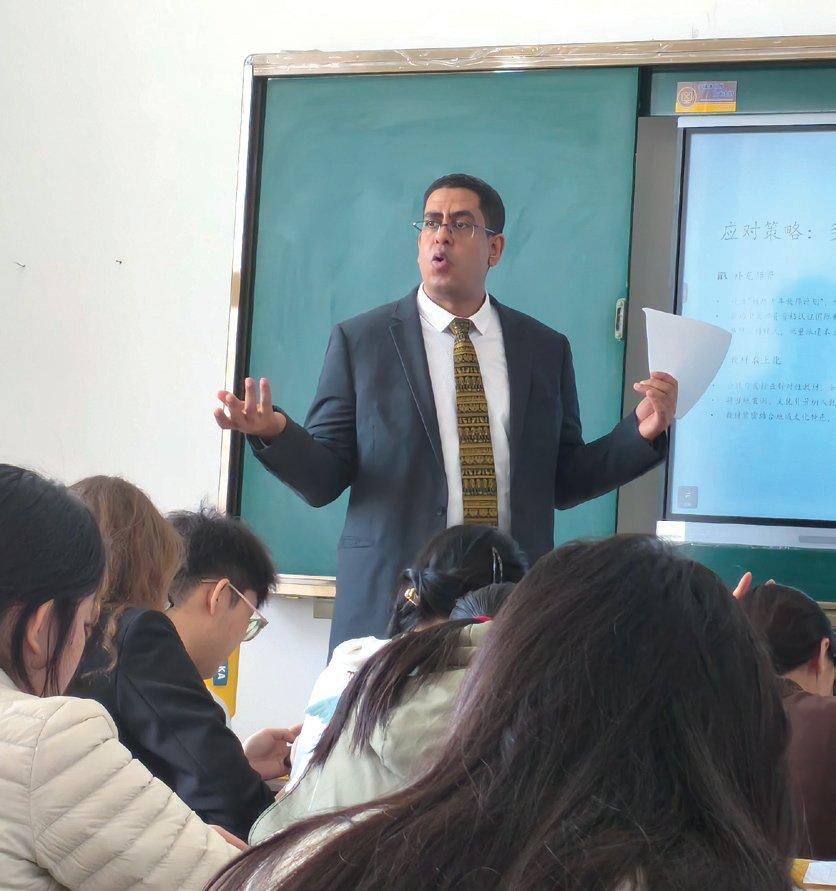
Moataz Abdellah in class
Dr. Moataz Abdellah (Chinese name: Wang Jianhao), an Egyptian teacher in the Teaching Chinese to Speakers of Other Languages major at the School of International Communication, joined Jilin International Studies University (JISU) in 2025. He primarily teaches courses such as “Research on Overseas Chinese Teaching”. With his passion for the Chinese language and culture, along with years of in-depth research and practice in international Chinese education, he has made outstanding contributions to the field. Recently, drawing on his teaching and practical experiences, Wang Jianhao shared his reflections and insights on teaching at our university.
“I was deeply impressed on my first visit to JISU”
I came to JISU in 2025. Before coming to China, I taught Chinese in Egypt for 14 years. Although I studied Chinese literature and earned my master’s and doctoral degrees in Chinese, to be honest, for all those years, I only knew China through books. I had been to China for short-term training, but I had never truly lived or worked here. I had always wanted to see what the working environment in a Chinese university was really like, and how Chinese university students actually study and live. So, after getting my PhD, I decided: I want to go to China and truly step into a Chinese university.
At that time, I contacted many schools and was eventually invited by Jilin International Studies University because of a recommendation from a good friend. He told me: This school is very special, particularly “warm”.
I was deeply impressed on my first visit to JISU. The campus is beautiful, and the buildings are very distinctive, but what attracted me more was the people here.
On the opening day, when I met with my colleagues at the School of International Communication for the first time, everyone was extremely welcoming. They didn’t just ask about my professional work; they cared more about whether I had any difficulties in my life—Had I found a place to live? Changchun’s winters are very cold, did I bring thick clothes? Was I used to the food? To be honest, I was a bit surprised and also a bit moved. I have been to many places, but rarely have I encountered such a warm “first meeting”.
Later, when I started working, my colleagues’ help never stopped. Some took me to get a mobile phone SIM card and a bank card; some told me which supermarket sold halal food. When I first arrived and wasn’t very good at using the university’s system, they would message me on WeChat after work to ask, “Is it sorted out?” Once, I felt unwell and didn’t go to the cafeteria, and the next day, a colleague asked me what was wrong and even brought me medicine.
None of these things were major events individually, but together, they made me feel that here, I am not a “foreign teacher” or a “foreigner”; I am treated like a family member.
At that moment, I knew: This is a place where I can stay with peace of mind.
“As a JISU teacher, one must teach students how to conduct themselves and do things”
When I first arrived, I was a bit nervous, worried that I wouldn’t adapt. But I soon discovered that the teachers here truly hold their students in the palms of their hands.
JISU’s educational philosophy, “all we do is for students to learn, grow and succeed,” initially seemed abstract to me. But after truly integrating into the university, I realized that this phrase is actually very concrete—so concrete that it applies to every class, every question, and every chat with students. In my view, it means: a teacher doesn’t just impart knowledge, but also teaches students how to be a good person and how to handle things.
As a foreign teacher, my way of practicing this is simple: in class, I don’t just talk about culture and literature; I also chat with the students, asking what they’ve been thinking about lately and if they have any worries. After class, if students message me with questions on WeChat, I always reply. Sometimes they come to me to chat not about studies, but about things in their lives, and I am willing to listen.
I believe that responsible education means making students feel that the teacher is genuinely listening to them and paying attention to their growth. It’s not just about seeing how many points they scored on a test, but seeing what kind of person they have become. So, in class, I often tell them one thing: “If you have any problems, feel free to find me, whether it’s about studying or anything else. I am here to accompany you as you grow up.”
“Scientific research makes the classroom more interesting”
In Egypt, our way of teaching is relatively traditional; the teacher talks a lot, and the students listen a lot, with relatively less interaction in class. At JISU, I found that there is a lot of interaction between teachers and students in class, and students are willing to ask questions and express their own ideas. I think this is a great advantage of JISU—students are not passive listeners, but actively learners.
I remember in my first semester, I gave several lectures on the ancient Silk Road, talking about the historical connections between the Arab region and China, and how Egypt and China communicated via the Silk Road in ancient times. Many students attended that time. They listened happily and surrounded me with many questions after it ended. I discovered that students are particularly interested in these extracurricular academic activities and can learn things that are not covered in class.
I think scientific research and teaching are inseparable. A teacher who doesn’t do research can only teach from the textbook in class; a teacher who does research can teach things beyond the textbook—the latest discoveries and their own reflections.
For example, I study comparative literature. When teaching about Arab culture in class, I use Arabic stories for comparison, such as what similarities exist between the stories in One Thousand and One Nights and Chinese folktales. The students immediately understood that cultures are interconnected. This is what we mean by “research feeding back into teaching”—research makes the classroom more interesting and lets students see a bigger world.
“International exchange allows students to view the world with an open mind”
International exchange is not just about sending students abroad or inviting foreigners to give lectures. I think what’s more important is letting young people from different countries truly “sit together and talk,” understanding each other’s lives and cultures.
For instance, in my classes, there are Egyptian students, Chinese students, and also Belarusian students. I often ask them to share their own country’s culture. The Egyptian students talk about the pyramids and Arab cuisine, the Belarusian students talk about winters in their country and traditional festivals, and the Chinese students talk about the Spring Festival and dumplings—as everyone listened, they realized that while we have so many differences, we also have so many similarities. Through this exchange, students learn more than what’s in the textbooks.
I believe the most positive role of international exchange is teaching students to view the world with an open mind. No matter what kind of work they do in the future, this mindset will help them.
“The working atmosphere at JISU is rare and precious”
The teachers at JISU give me the greatest impression: they are very busy themselves, but as long as you need help, they will definitely stop to help you.
There is one thing I will never forget. Last November, I was invited by the China International Communications Group to participate in the “Overseas Think Tanks Focus on Xinjiang” activity in Xinjiang. Before departure, many procedures needed to be handled. I was unfamiliar with the university’s system and completely didn’t know where to start. Professor Ma Shuang from the School of International Communication proactively helped me, telling me step by step how to fill out the forms, who to get signatures from, and where to submit them. The procedures were complicated, and she ran back and forth for me several times. What touched me especially was—one night, she was still messaging me, asking: “Are all the procedures sorted out? Is there anything else you need help with before you leave?” It was only when I replied that I learned a family member of hers had passed away that very day. While dealing with her family matters, she was still thinking about whether my procedures were completed.
I didn’t know what to say at the time. I feel that working here, I am not a “foreign teacher” or a “foreigner”; I am truly treated as an “insider”. This kind of atmosphere is rare, and I cherish it very much.
“JISU students are very hardworking and also very kind”
Regarding the students at JISU, what impressed me the most is—they are very hardworking and also very kind.
Once, I started writing an academic paper on Chinese web literature, which required a lot of reference materials. I found some myself, but it still wasn’t enough. Unexpectedly, several students found out about this and proactively helped me download materials, sending them to my email. Later, when I asked them how they found them, they said: “Teacher, our library has databases, we searched them for you, and there were a few articles that friends at other universities helped download.”
I was truly moved at that moment. They don’t just come to class to learn knowledge; they genuinely treat their teachers as friends and are willing to spend time helping them.
Also, my students are very serious in class and very brave. They are not afraid of making mistakes and are willing to speak foreign languages. I think this is the most important quality in learning a language—daring to speak, daring to make mistakes, and daring to learn.
“Teaching students how to tell China’s stories well”
My original intention in teaching Chinese is very simple: because I learned Chinese, it changed my life.
From my undergraduate studies at Al-Azhar University, to my master’s and doctoral degrees at Ain Shams University, and then becoming a teacher at an Egyptian university, Chinese has led me on a very long journey. Over the years, I have also been actively participating in international Chinese education exchanges—attending international forums on Chinese teaching multiple times; in 2013 and 2015, I served as the host for the “Chinese Bridge” Egyptian regional competitions; in 2022, I won an Encouragement Award in the Beijing Language and Culture University anniversary poetry recitation contest; last November, I also participated in the “2024 Young Sinologists Program” held at Nanjing University.
These experiences have made me more determined: I hope more Egyptians can also see a bigger world through the Chinese language.
My bond with Chinese culture started with a book. When I was in graduate school, I read Yu Hua’s novels for the first time and was deeply moved. It turns out that the joys and sorrows of the Chinese people are the same as those of the Egyptians. From then on, I thought, I want to tell these stories to more people.
How can students become the “bridges and ties” for the external communication of the Chinese language and culture? I think the most important thing is: teaching them how to tell stories well. It’s not just about telling how great China is, but telling about the lives and emotions of the Chinese people. Cultural communication isn’t about reciting data; it’s about making people understand and making them moved. I often tell my students: “If you can make a foreigner want to learn Chinese and want to come to China to see it after listening to your story, then you have succeeded.”
“Spreading the JISU story”
In the future, my goal is simple: continue to be a good teacher and continue to do my research well.
I hope JISU will become more and more “international”. Not only letting Chinese students go out, but also letting more foreign teachers and students come in. When they come, the story of JISU will spread out.
As for myself, I am willing to be that “storyteller”. When the university needs it, I will help receive foreign friends and participate in international exchange activities, telling the JISU and the China I see to my Egyptian and Arab friends.
I have been in Changchun for almost two years and already consider myself a part of JISU. If the university thrives, I thrive. As the university moves forward, I am willing to keep following along.
Source: Issue No. 580 of the University Newspaper
