
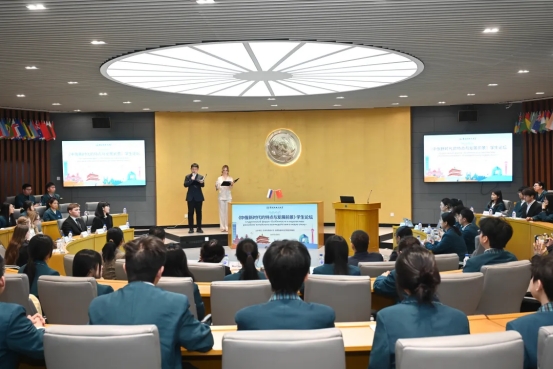
The year 2026 marks the China-Russia Year of Education. To deepen practical cooperation in the field of education between the two countries, broaden channels for people-to-people and cultural exchanges, cement the foundation of intergenerational friendship, and promote mutual understanding and mutual learning among Chinese and Russian youth, on April 9, the Student Forum on “Characteristics and Development Prospects of the New Era of China-Russia Relations,” co-hosted by Jilin International Studies University (JISU) and the Consulate General of the Russian Federation in Shenyang, was held at the Global Village of JISU.
This forum was the first event organized in Jilin Province by the Consulate General of the Russian Federation in Shenyang under the framework of the China-Russia Year of Education. With academic exchange as its centerpiece, it focused on the characteristics and development prospects of China-Russia cooperation in the new era, providing a significant platform for young students from both countries to exchange ideas, build consensus, and envision the future together, empowering the high-quality development of China-Russia relations with youthful energy. Natalia Przhikova, Consul General of the Russian Federation in Shenyang; Gao Bin, Director of the Department of International Cooperation and Exchange of the Jilin Provincial Department of Education; and Professor Wang Zhiguo, Vice President of JISU, attended the opening ceremony and delivered speeches. They all expressed that they would actively respond to the initiative of the China-Russia Year of Education, deepen cooperation, build bridges of communication, promote the growth and development of youth, and contribute to the continuation of the China-Russia friendship. Wang Kai, Deputy Director of the Eurasian Division of the Foreign Affairs Office of Jilin Province, and Zhou Shujuan, Dean of the School of Central and Eastern European Languages at Jilin International Studies University, also attended the event.
Afterwards, eight Chinese students from Jilin International Studies University and six Russian students from Moscow State Institute of International Relations (MGIMO) delivered presentations in turn, delivering keynote reports on the theme of “Characteristics and Development Prospects of the New Era of China-Russia Relations” from various aspects including educational exchange, people-to-people connectivity, economic development, and industrial cooperation. After each report, an interactive Q&A session was held, allowing Chinese and Russian students to engage in in-depth exchanges, broaden their horizons through the exchange of perspectives, and enhance mutual understanding through the integration of ideas.
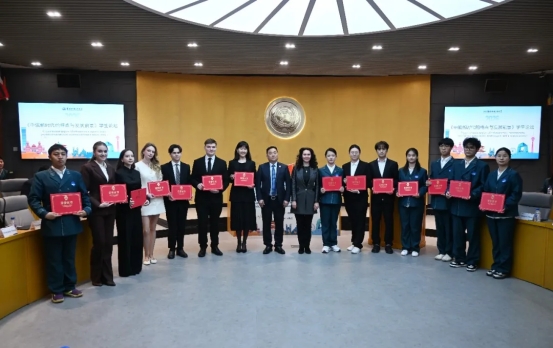
At the closing ceremony, the Consulate General of the Russian Federation in Shenyang presented honorary certificates to the Chinese and Russian students for their outstanding research achievements.
As a key provincial university in Jilin Province, JISU has always adhered to its educational philosophy of “non-profit, application-oriented, and international,” deeply cultivating the field of foreign-related education. The university established its Russian language major in 2004, which is now a first-class undergraduate program in Jilin Province. Since 2012, it has enrolled master’s degree candidates in the Russian interpretation direction of the MTI (Master of Translation and Interpreting) program. Currently, it offers one national-level first-class course, two provincial-level first-class courses, and one provincial-level quality course, and has established a provincial-level outstanding teaching team. In 2022, it successfully obtained the “Russia-Ukraine-Belarus International and Regional Studies and High-Level Translation Talent Training Program” project approved by the China Scholarship Council (CSC). The university has established cooperative relationships with more than 30 well-known foreign universities, including Moscow State University, playing an active role in Jilin Province’s educational exchanges and cooperation with Russia.
The university has long maintained close ties with the Consulate General of the Russian Federation in Shenyang and Moscow State Institute of International Relations, enjoying a solid foundation for cooperation and a deep bond of friendship. This joint effort to host the student forum not only provided a crucial platform for young students of the two countries to communicate, dialogue, and exchange ideas, but also injected new momentum into the sustained development of China-Russia educational undertakings in the new era.
The forum activities received an enthusiastic response from the Chinese and Russian youth participants. They all expressed that they would interpret the contemporary significance of China-Russia cooperation from a youthful perspective and contribute their wisdom to the sustainable development of China-Russia relations.
Zhong Minghui, a postgraduate student (Class of 2025) majoring in Russian translation for the Master of Translation and Interpreting program at the Graduate School of Translation and Interpreting, said: “This forum activity has made me deeply realize that bilateral relations exist not only in diplomatic documents and news headlines, but are also deeply rooted in the understanding and interaction of the younger generation. Young people are not only witnesses to China-Russia friendship but should also become active participants and builders, adding warm and steadfast strength to promote deeper cooperation and future development between the two countries. I believe that as long as our generation treats each other sincerely and walks hand in hand, China-Russia relations in the new era will certainly become even brighter.”
Pavel Dzhamai, a third-year student in the Department of Management and Politics at MGIMO, said: “I am very honored to have been invited to this conference. It gave me the opportunity to learn about research in different fields and to meet many outstanding students. The theme of my presentation was on China-Russia cooperation in the Arctic region, which I believe is significant in terms of energy, scientific research, and environmental protection. Through this conference, I not only shared my research results but also learned many new perspectives and ideas. Such activities also help promote friendship and cooperation between China and Russia, deepen mutual understanding, and are a truly valuable experience.”
