
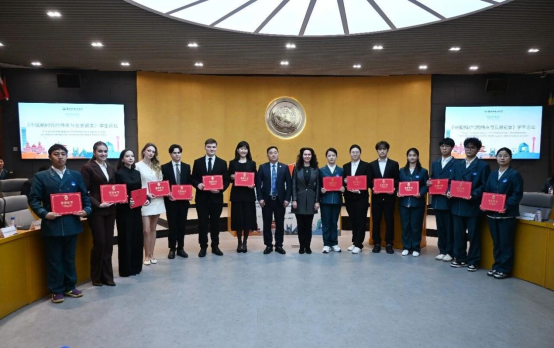
Natalia Sergeevna RYZHKOVA, Consul General of the Russian Federation in Shenyang, and Wang Zhiguo, Vice President of JISU, present honorary certificates to the student speakers.
The year 2026 marks the China-Russia Year of Education. To deepen practical cooperation in education between the two countries, broaden channels for people-to-people and cultural exchanges, lay a solid foundation for lasting friendship between generations, and facilitate mutual understanding and mutual learning between Chinese and Russian youth, the Student Forum on “Characteristics and Development Prospects of the New Era of China-Russia Relations” was held at the Global Village of JISU on April 9, co-hosted by JISU and the Consulate General of the Russian Federation in Shenyang.
The forum was the first event of the China-Russia Year of Education to be held in Jilin Province, organized by the Consulate General of the Russian Federation in Shenyang. Eight students from the School of Central and Eastern European Languages and the School of International Relations of JISU, together with six Russian students from MGIMO University, gave presentations on the theme “Characteristics and Development Prospects of the New Era of China-Russia Relations,” covering topics such as educational exchanges, cultural and people-to-people exchanges, economic development, and industrial cooperation. The students responded enthusiastically to the forum, all expressing their commitment to interpreting the contemporary connotations of China-Russia cooperation from a youthful perspective and contributing their wisdom to the sustained development of bilateral relations.
▲ Interpreting the Contemporary Connotations of China-Russia Cooperation from a Youthful Perspective
Shen Zhuowen, from Class 2401 of the International Affairs and International Relations program at the School of International Relations, said: “My presentation focused on the transformation and prospects of China-Russia cooperation in the automotive industry. In my preliminary research, my greatest takeaway was that China-Russia cooperation is moving from traditional trade complementarity toward deeper capacity co-building. The automotive industry, especially new energy vehicles, is becoming a new platform for technological coordination, standards alignment, and talent cultivation. This has also given me a deeper appreciation of the strategic significance and far-reaching impact of economic, trade, and industrial cooperation in deepening the China-Russia comprehensive strategic partnership of coordination for a new era.”
Xu Qingzhe, from Class 2301 of the Russian Language program at the School of Central and Eastern European Languages, said: “This forum allowed me to step beyond textbooks and classrooms and gain a more comprehensive and genuine understanding of the profound connotations of China-Russia cooperation in the new era, while also filling me with confidence in the future of our bilateral relations. Through my presentation, I came to realize that China-Russia cooperation covers three major areas: politics, economy, and people-to-people exchanges. Political mutual trust is the cornerstone of our relations. Both sides support each other on core interests and jointly uphold fairness and justice on the international stage, contributing significantly to global stability. Economic and trade cooperation has yielded remarkable results, with mutually beneficial cooperation in energy, trade, and technology driving economic growth while also delivering tangible benefits to the peoples of both countries. People-to-people and cultural exchanges, moreover, are the soul of our bilateral relations: student exchanges, language and cultural centers, and artistic interactions bring our hearts closer and add warmth to our cooperation. Language builds bridges of communication, while culture connects hearts. As young students, we are not only witnesses to China-Russia friendship but should also become active participants and ambassadors for it. Learning Russian and understanding Russian culture is not just about self-improvement; it also lays a foundation for promoting exchanges.
Nong Wudong, from Class 2401 of the International Affairs and International Relations program at the School of International Relations, said: “The forum focused on the China-Russia comprehensive strategic partnership of coordination for a new era. I shared achievements and prospects in cultural and educational cooperation between the two countries. From the “Year of Russia” in China and the “Year of China” in Russia to the China-Russia Years of Culture and the China-Russia Years of Education, and from the growing scale of two-way study abroad programs to Confucius Institutes and Russian language centers, as well as joint educational programs and collaborative research between universities, these achievements gave me a vivid sense of the breadth and depth of China-Russia people-to-people and cultural cooperation. I also deeply realized that cultural and educational exchanges serve as a bridge for connecting hearts and a vital link in fostering friendship between generations.”
▲ Harnessing Youth Strength for the Sustained Development of China-Russia Relations
Feng Lei, a 2025 graduate student in the MTI Russian Translation program at the School of Central and Eastern European Languages, said: “Face-to-face communication with Russian classmates made me deeply realize that young people are an important bond in China-Russia friendship, and that well-rounded translation professionals who are proficient in both languages and familiar with the two countries are key to bridging the two sides. This forum has further clarified my professional mission. In the future, I will continue to deepen my expertise in Russian translation, facilitating the translation of academic works between the two countries, youth exchanges, and cooperation across various fields, contributing to China-Russia friendly exchanges.”
Wang Min, from Class 2301 of the Russian Language (Sino-Foreign Cooperative Education) program at the School of Central and Eastern European Languages, said: “I used to think that China-Russia relations were a major national affair, far removed from us students. But after listening to everyone discuss economic and trade cooperation, cultural exchanges, and youth interactions, I realized that the development of China-Russia relations in the new era is closely related to us. Learning Russian and understanding Russian culture is, in fact, our participation in friendly exchanges between the two countries. Keeping up with developments in both countries also helps us gain a more comprehensive and deeper understanding of China-Russia relations.”
Tan Lingling, from Class 2401 of the International Affairs and International Relations program at the School of International Relations, said: “This forum deepened my understanding of the multifaceted nature of China-Russia relations. In the past, I focused more on macro strategies, but the presentations by students from both countries showcased cooperation in specific fields such as industry, environmental protection, and aerospace, showing me that the comprehensive strategic partnership has extended into a wide range of practical areas. Youth are the future of China-Russia relations, and we are not just witnesses but also participants and builders.”
Han Tianyang, from Class 2401 of the International Affairs and International Relations program at the School of International Relations, said: “At the forum, Chinese and Russian youth engaged in in-depth discussions and freely expressed their views on topics such as bilateral development and people-to-people exchanges. Listening to the Russian students’ sharing, I felt the charm of different cultures and learned to view international issues from diverse perspectives. I will take this as motivation to refine my professional knowledge, strive to improve my overall competence, and aspire to become a youth ambassador for China-Russia cultural exchanges, contributing my youthful energy to the friendly development of our two countries through concrete actions.”
Xu Qingzhe said: “This forum gave me not only knowledge but also a sense of responsibility and direction. In the future, I will work harder to enhance my professional skills and language proficiency, actively follow developments in China-Russia exchanges, participate in cultural interaction activities, and act as a youth envoy for China-Russia friendship. I firmly believe that, with the joint efforts of our peoples, the China-Russia comprehensive strategic partnership of coordination for a new era will continue to make steady and sustained progress, cultural and educational ties will continue to deepen, and our friendship will be passed down from generation to generation, growing ever stronger.”
