
On June 18th , seventeen Indonesian teachers and students from the Center for Chinese Education in Indonesia attended the opening ceremony of JISU Chinese Camp in the China Village of the Global Village. In the next fourteen days, they will learn Chinese language and culture for exchanges and experience in Jilin International Studies University (JISU).
At this meaningful moment when Chinese and Indonesian young students communicated with each other, Song Dandan, the Director of the Office of International Exchanges and Cooperation, also the Dean of School of International Exchange (SIE) and Mo Qingyu, the leading teacher of Indonesian students, attended and addressed the opening ceremony, with volunteers from School of International Communication and School of Oriental Languages joining together.
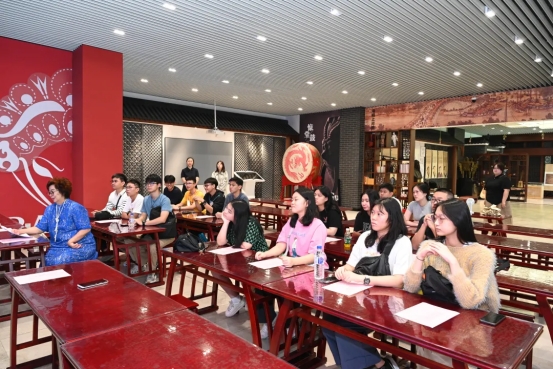
Indonesian teachers and students attended opening ceremony in China Village
Song Dandan extended sincere greetings to Indonesian teachers and students coming afar, with an emphasis on language functioning as a vital bridge in people-to-people exchange, expressing hopes that young students from the two countries will regard JISU Chinese Camp as a precious platform for mutual understanding and will cultivate friendships through exchanges. In the speech, Mo Qingyu said that through the window of JISU Chinese Camp, Indonesian students can gain immersive experiences of dynamic modern China and profound Chinese culture, as well as long-lasting enthusiasm towards Chinese language learning.

Chinese dance Glorious Dunhuang
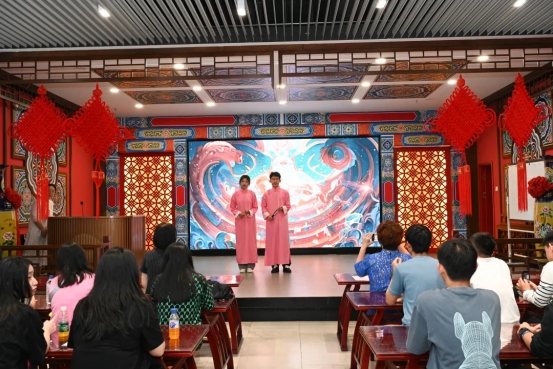
Crosstalk (Xiangsheng) Traditional Culture
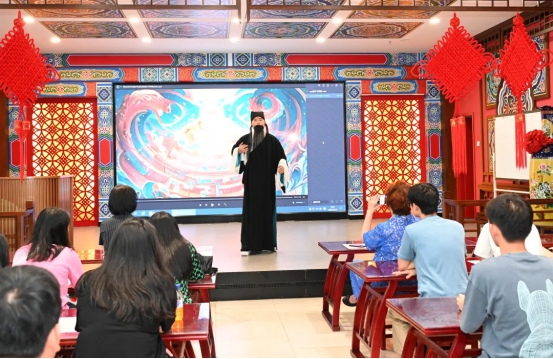
Peking Opera Mi Heng’s Denouncement of Cao Cao
At the opening ceremony, cultural performances brimming with distinctive Chinese charm won a full house of applause. Among them, Chinese Dance, Glorious Dunhuang was a vivid representation of Dunhuang, the pearl of the Silk Road over millennia; Crosstalk, Traditional Culture was an aesthetic combination of traditional Chinese customs and wisdom; Peking Opera Mi Heng’s Denouncement of Cao Cao was the epitome of unique and profound Peking Opera.
JISU has accrued years of experience in hosting the short-term Travel-to-China Program. Based on successful examples, JISU Chinese Camp is believed to apply a teaching mode combining language learning and cultural experience, highlighting the cultures of Northeastern China and folkways. In JISU Chinese Camp, Indonesian students will not only learn Chinese culture behind language, but also tour many scenic spots of Jilin, such as Jilin Science and Technology Museum, FAW Hongqi Cars Pavilion, Jilin Provincial Museum of Traditional Chinese Medicine, Beijing Dajiexi Cultural Street Block, Journey to the West theme park in Changchun Zoological and Botanical Park, and Changchun Film Leisure Culture Park Lotus Island. They will also enjoy a feast of traditional Chinese foods and learn to make dumplings. Furthermore, Indonesian students will understand the uniqueness of outstanding traditional Chinese culture in all respects through the Traditional Chinese Culture Workshop Courses, like Paper Cutting, Movable-type Printing, Chinese Calligraphy, Chinese Knot, Taiji Fan, Staw Weaving Art, and Tea Ceremony, all of which are delicately designed by JISU. With the aim of increasing understanding and integration, the China-Indonesia Students Seminar will be held for Indonesian students, JISU students majoring in Teaching Chinese to Speakers of Other Languages, and JISU students majoring in Indonesian, discussing cultural topics such as traditional festivals in both China and Indonesia, as well as the Chinese zodiac.
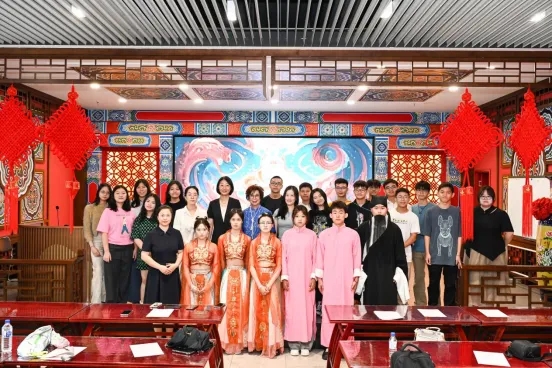
A group photo of Chinese and Indonesian teachers and students at opening ceremony
Indonesian teachers and students said, “JISU gives us a warm amiability with scenic beauty, international dynamic, and friendliness of JISU’s teachers and students. We hope JISU Chinese Camp will serve as a platform for Chinese language learning, a path to experience opulent Chinese culture and art in person, and a bridge of friendship with teachers and students in JISU. We believe that memory will be engraved in our minds throughout life.”
