
On April 22, China News Service published a story titled “Dialogue of Civilizations Between Pages: Egyptian Teacher in Changchun Reads the Resonance Between China and Egypt,” featuring Mr. Wang Jianhao, an Egyptian teacher at Jilin International Studies University, who visited the “Zhe You Shu” bookstore in Changchun and observed the city’s bookstore ecosystem and national reading practices from a cross-cultural perspective.

Dialogue of Civilizations Between Pages: Egyptian Teacher in Changchun Reads the Resonance Between China and Egypt
CHANGCHUN, April 22 (China News Service) — “Books are a key; they open the door for you, but you must walk through it yourself.” On the eve of the 31st World Book Day, warm light filled the aisles of the “Zhe You Shu” bookstore in Changchun, Jilin. Egyptian teacher Wang Jianhao wandered through the shelves, his gaze lingering on the Chinese science fiction section.
Having devoted nearly 22 years to the study of Chinese, Wang taught Chinese language for 14 years in Egypt before crossing oceans to China in 2025 to join the School of International Communication at Jilin International Studies University.
Bookstores are Wang’s favorite places to visit in Changchun. Spanning over 10,000 square meters, “Zhe You Shu” features a 24-hour smart reading room and a diverse mix of integrated formats, which he finds refreshing. “It’s very modern here—not just a place to buy books, but also with a cafe, cultural creative zones, and camping-style reading corners. It’s a spiritual haven where you can comfortably spend an entire day.”
As a book lover from Egypt, Wang is accustomed to examining bookstore culture from a cross-cultural perspective. “In Egypt, bookstores have distinct functional divisions—some can host various cultural events but do not sell books; others sell books but cannot hold related activities,” he explained. “Zhe You Shu” offers him a completely different experience. “Not only can I find books about Egyptian culture here, but it also covers a wide range of multicultural readings—it is extremely inclusive.”
As a researcher of comparative literature, Wang’s reading spans the two great civilizations of Egypt and China. Yu Hua’s Seventh Day is one of his favorite Chinese novels and was the focus of his doctoral dissertation, in which he compared it with the works of Egyptian writer Youssef Sibai to explore the commonalities and differences in the concept of life and death between Egyptian and Chinese literature. “I discovered striking similarities between the Chinese and Egyptian views on life and death—we both firmly believe that life may end, but love and memory never fade,” Wang remarked. This resonance across civilizations, he said, is a unique insight bestowed by books.
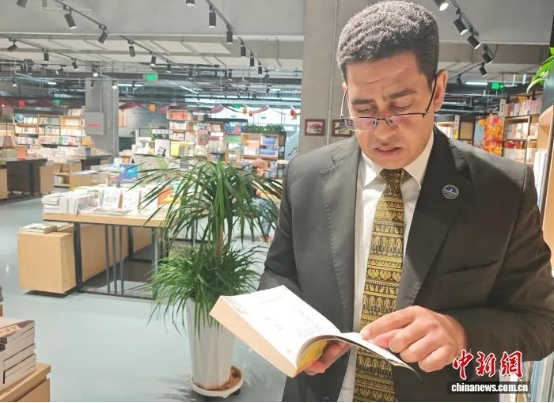
Wang Jianhao reading the Chinese sci-fi novel The Three-Body Problem. (Photo by Tan Weiqi)
Among the sea of books, science fiction is Wang’s favorite genre, with The Three-Body Problem and The Wandering Earth particularly captivating him. “The Three-Body Problem is astonishing—it is not merely a sci-fi work but also contains profound reflections on humanity and civilization. The author’s imagination is truly remarkable,” he said. Wang noted that while Arabic literature also boasts many fine sci-fi works, their scale is objectively smaller than that of China’s.
In Wang’s view, books have opened multiple windows for him to understand China: “From books, I see a China with a rich history and also a China full of imagined futures—each aspect is fascinating.” As a cultural bridge between the two nations, he teaches Arabic to Chinese students and Chinese to Arabic students. “In my teaching, I find that whether Chinese or Arabic students, what they are most curious about is always the literary classics of the other country.” He believes reading is not only an effective way to learn a language but also the shortest path to understanding a culture and entering the soul of a people.
Regarding the differences in reading habits between Chinese and Egyptian people, Wang has made careful observations: with China’s rapid modernization, Chinese readers tend to prefer e-books, making portable and anytime reading the norm; while e-books are also developing in the Arab region, the pace is relatively slower, though more and more Arabs are now also adopting the habit of reading on the go.
The year 2026 marks the first year of implementation of China’s Regulations on Promoting National Reading. Changchun has launched a variety of reading activities with rich content and diverse formats. “In Egypt, large-scale national reading campaigns like this are rarely seen. The way China turns reading into a city-wide festival is both novel and infectious,” Wang said with admiration.
