
Recently, the School of Central and Eastern European Languages held a cultural exchange activity at the Russian Village of the Global Village of JISU. International students from seven countries—Russia, Belarus, Poland, Hungary, the Czech Republic, Ukraine, and Serbia—joined hands with Chinese students to interact through music, dance, folk custom displays, and tea culture tasting. Nearly 100 students participated in the event.
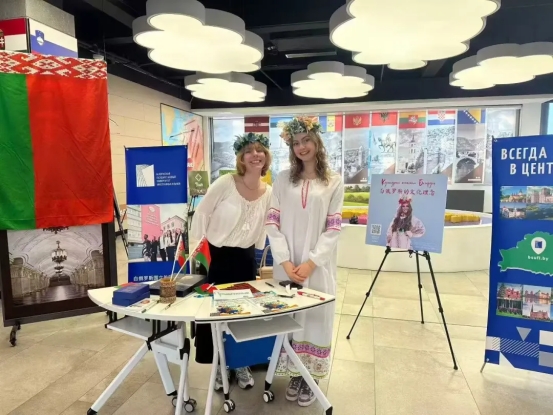
Belarusian international students Darya and Sofia introducing the cultural concepts of Belarus
In the “Getting to Know Central and Eastern European Countries” segment, student representatives from seven countries took the stage in turn, sharing stories of ethnic integration in their own countries, displaying traditional patterns, and introducing folk cultures. The “Guess the Country” interaction was full of fun, with all teachers and students actively responding, drawing continuous applause from the audience.
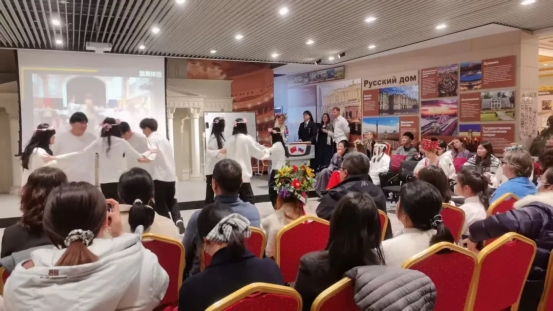
The “Friendship Dance” Segment
As folk music played, the activity reached the climax of the “Friendship Dance”. Dressed in traditional costumes, the students joined hands to form concentric circles, dancing to melodies such as the Russian Kalinka and the Polish Polonaise. The different dance steps together played the main theme of unity and friendship.
The tea party area displayed Central and Eastern European specialty pastries and set up a tea tasting area, featuring Russian black tea, dark tea, and more. The students sat around drinking tea and conversing, exchanging ideas about tea culture, allowing the concept of "making friends through tea" to radiate transnational charm.
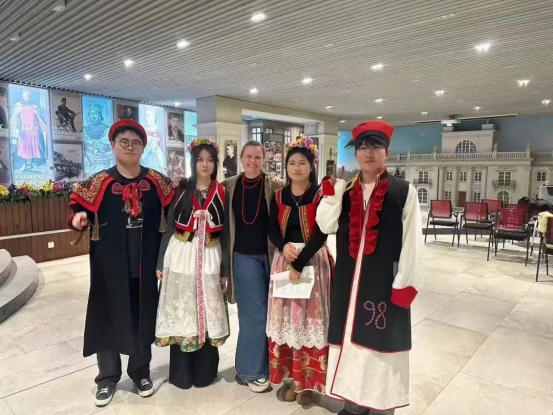
A group photo of students from the School of Central and Eastern European Languages and foreign teachers at the event venue
This event fully demonstrated the purpose of “cooperation, sharing, and friendship,” deepening transnational friendship through experience. The School of Central and Eastern European Languages will continue to cultivate the construction of cross-cultural exchange brand activities, build a broader interactive platform for Chinese and international students, further promote cross-cultural communication, and continuously advance mutual learning between civilizations and people-to-people connectivity.
Source: School of Central and Eastern European Languages
