
Recently, the Department of Higher Education under the Ministry of Education announced the Public Notice on the Third Batch of National First-Class Undergraduate Course Selections. A total of 5 courses from Jilin International Studies University—Introduction to Italy, Basic Russian III, Intensive Reading of Basic French I–IV, English-Chinese Translation, and College English—have been recognized as national first-class undergraduate courses. These span three major categories: online, offline, and hybrid first-class courses.
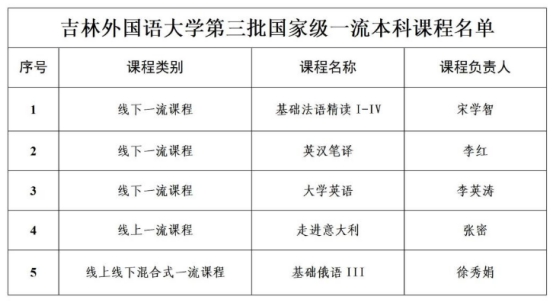
List of the Third Batch of National First-Class Undergraduate Courses at Jilin International Studies University |
|||
Number |
Course Type |
Course Name |
Course Leader |
1 |
Offline First-Class Course |
Intensive Reading of Basic French I–IV |
Song Xuezhi |
2 |
Offline First-Class Course |
English-Chinese Translation |
Li Hong |
3 |
Offline First-Class Course |
College English |
Li Yingtao |
4 |
Online First-Class Course |
Introduction to Italy |
Zhang Mi |
5 |
Hybrid First-Class Course |
Basic Russian III |
Xu Xiujuan |
List of the Third Batch of National First-Class Undergraduate Courses at Jilin International Studies University
In recent years, guided by the “Double Ten-Thousand Plan”, the university has further promoted Curriculum Ideology and Politics as well as the development of Gold Courses. Through measures such as refining course quality standards, strengthening the development of teaching teams, and building digital teaching resource platforms, the university has established 8 national first-class courses, 24 provincial first-class courses, and 95 university-level first-class courses. This forms a three-tier “national–provincial–university” linkage system for cultivating first-class curricula. The selection of these 5 courses reflects the university’s long-term commitment to enhancing undergraduate teaching and deepening educational reform.
Moving forward, the university will leverage this achievement in national first-class course development to fully demonstrate its exemplary and leading role. This will help elevate the overall quality of courses across the institution and contribute significantly to building high-quality undergraduate education and serving national strategic needs!
